
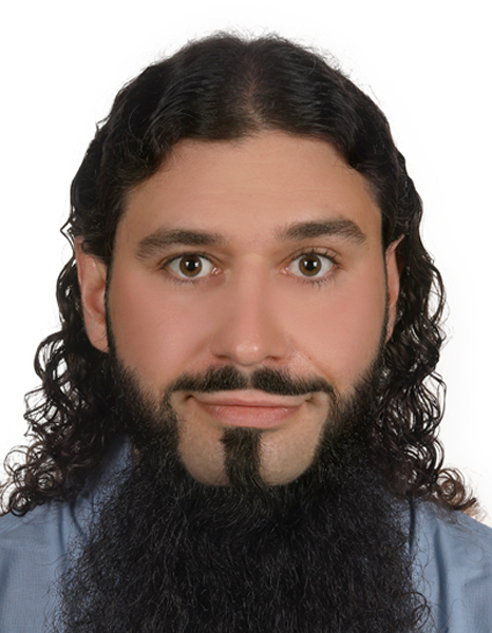
mgr Szymon Góźdź
ORCID: 0000-0002-2515-0262
The topic of my dissertation is: “Philosophical Experience of the Sacred in Christian Art (The Limits of Reason and Faith)”
Supervisor: dr hab. Krzysztof Bochenek, Associate Professor at the University of Rzeszów
My research interests lie at the intersection of philosophy, theology, anthropology and art history. I combine an active artistic practice (I am a painter and a member of the Association of Polish Artists and Designers, ZPAP – Wrocław branch) with a strictly theoretical background in philosophy and art mediation. I specialise in Byzantine and post-Byzantine sacred art – above all the icon, its canon and its liturgical, doctrinal and cultural contexts – as well as in contemporary conceptual art. Between 2018 and 2023 I conducted field research in the ethnically, religiously and culturally diverse area of the Balkan Peninsula (Bulgaria, Serbia, North Macedonia, Albania and Romania, including historical Transylvania and Moldavia). Since 2026 I have extended my field research to the geo-cultural borderland between Europe and the Middle East (Greece, Turkey, Cyprus, as well as issues concerning the Maronites in Lebanon). In addition to this grant-funded field research, I completed a research residency at the Bulgarian Academy of Sciences in Sofia under the NAWA PROM programme (2020) and a one-month research internship at the University of Vienna under the NAWA STER programme (2026).
The dissertation I am currently preparing falls within the research area “Reason” in the face of faith (anthropological, axiological and ideological contexts): fideism versus rational justifications of faith (Eastern and Western Christianity). Its subject is the tension between rationality and irrationality in sacred art, understood as an expression of the theology and philosophy of the Christian East and West. I ask how doctrinal disputes – Origenism, Iconoclasm and the Triumph of Orthodoxy, fideism – have left lasting traces in artistic forms and in the ways these forms are received; how Eastern and Western conceptions of the sacred image diverged after the Great Schism, together with scholasticism and the Western theory of the image; what cognitive and emotional mechanisms are triggered by contact with a work of sacred art; and, finally, whether rationality and irrationality can be reconciled in the experience of the sacred.
Methodologically, the work has a deductive structure: it proceeds from broad philosophical, theological and cultural contexts to detailed case studies. My aim is to bring together a critical, hermeneutic analysis of sources (the writings of the Church Fathers, conciliar documents and iconographic treatises, including the Hermeneia of Dionysius of Fourna) with a historical-comparative analysis of both traditions and an analysis of selected works of art.
The theoretical part will be confronted with empirical material gathered in the field: participant observation among icon painters and creators of contemporary religious art, in-depth interviews with artists, clergy and viewers, and research into the perception of selected works.
My working hypothesis is that the experience of the sacred in art cannot be reduced to a simple division into the rational and the irrational, but forms a dynamic field of tension and dialogue between these two poles: in the sacred art of the East, the expression of the irrational – or rather the suprarational – prevails as the vehicle of religious experience, whereas the West gradually shifted the emphasis towards a rationalisation of the image.
I expect the dissertation to offer an interdisciplinary approach linking the philosophy of religion, aesthetics and the anthropology of art; original empirical material documenting how the sacred is experienced in contemporary religious and artistic communities; and new theoretical proposals that go beyond established divisions, opening a fresh perspective for research on the sacred and for dialogue between the traditions of the Christian East and West.
Selected publications:
- Góźdź S., Działalność, struktura i znaczenie Galerii „Pod Moną Lisą” [The Activity, Structure and Significance of the “Pod Moną Lisą” Gallery], Uniwersytet Artystyczny w Poznaniu, Poznań 2019 (monograph).
- Góźdź S., Produkty, meandry, kwadraty i przestrzenie krytyki artystycznej Stanisława Witkiewicza [Products, Meanders, Squares and Spaces of Stanisław Witkiewicz’s Art Criticism], [in:] D. Milecka, A. Drohomirecki (eds.), Kwadratowe obłoki. Konstruktywizm i awangarda: teoria, retrospektywa, wpływ, Wydawnictwo ASP we Wrocławiu, Wrocław 2019.
- Góźdź S., Recepcja i swoistość. Bułgarskie malarstwo ikonowe od IX do XII wieku [Reception and Distinctiveness: Bulgarian Icon Painting from the 9th to the 12th Century], “Studia Redemptorystowskie” 2020, no. 18.
- Góźdź S., Woźniak J., The Image Codified: Dionysius of Fourna’s Hermeneia as a Source of Interpretation of the Canon Law Dogmatics of the Icon, “Teologia i Człowiek” 2023, vol. 62, no. 2.