
Profil naukowy / Scientific profile
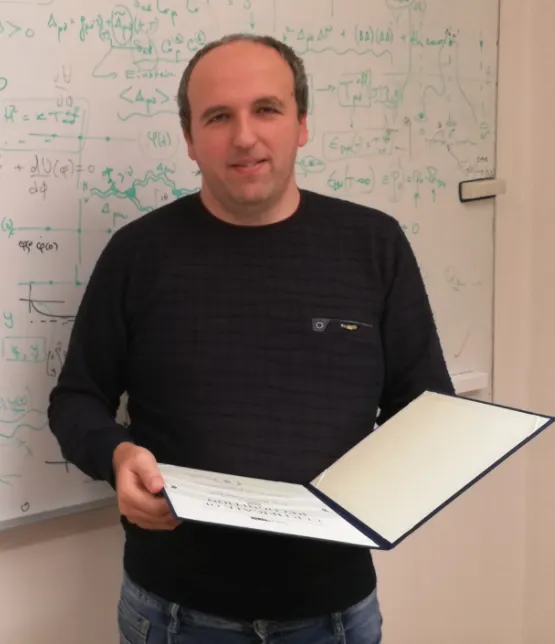
Roman Pasechnik is Associate Professor (Docent) of Theoretical Physics at the Department of Physics, Faculty of Science, Lund University, Sweden. His research explores the fundamental constituents of matter and their role in the evolution of the Universe. His interests span quantum chromodynamics, the theory of the strong interaction, as well as Higgs physics, theories beyond the Standard Model, dark matter and gravitational waves from cosmological phase transitions. He contributed to the identification of Odderon exchange through analyses of high-energy proton–proton and proton–antiproton scattering. His work also investigates dark glueballs as composite dark-matter candidates, including their cosmological abundance and prospects for experimental detection. Alongside particle physics and cosmology, he works on complex systems, nonextensive statistical mechanics and applications of machine learning in physics. His interdisciplinary interests include how correlations, memory and nonadditive entropy help describe complex phenomena across different fields.
He has authored or co-authored more than 160 peer-reviewed journal articles, and his work has received over 6,000 citations in INSPIRE-HEP. His international experience includes visiting professorships in Brazil, Chile, the Czech Republic, China and Poland, and collaborations connecting theoretical research with collider experiments and astrophysical observations.
Teaching and the development of early-career researchers are central to his academic work. At Lund, he coordinates the Master’s programme in theoretical particle physics and teaches quantum field theory, cosmology and astroparticle physics, and classical mechanics. He supervises undergraduate and Master’s research projects, doctoral students and postdoctoral researchers, including through joint international doctoral programmes. His international teaching includes advanced courses in quantum field theory, quantum chromodynamics and particle physics, as well as modern machine learning and artificial intelligence.
He is a member of the International Union of Pure and Applied Physics Commission on Particles and Fields (IUPAP C11) and has represented Sweden in the European Committee for Future Accelerators (ECFA). He serves on scientific editorial boards and evaluates research proposals and doctoral theses internationally. He has organised international conferences and advanced schools on dark matter, strong interactions and machine learning, and chairs the forthcoming Nobel Symposium 215, “Beyond Boltzmann: Complexity, Memory, and Non-Additive Entropies”, to be held in Sweden in May 2027.
