Aktualności
Sulforafan jako nowa broń przeciw lekooporności komórek nowotworowych/ Sulforaphane as a novel weapon against drug resistance in cancer cells
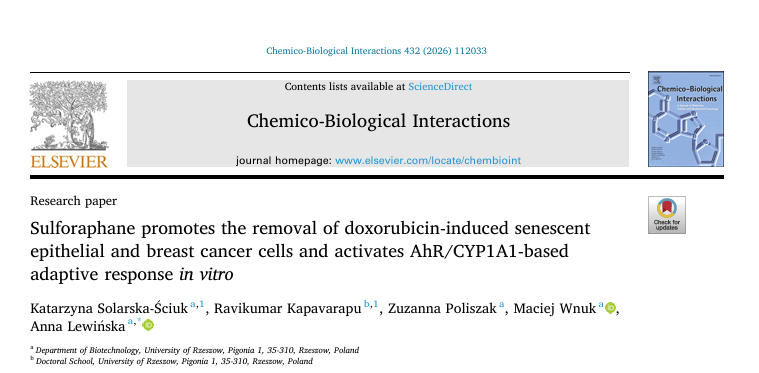
Zespół badawczy Wydziału Biotechnologii Collegium Medicum Uniwersytetu Rzeszowskiego w składzie: dr Katarzyna Solarska-Ściuk, mgr Ravikumar Kapavarapu (doktorant), Zuzanna Poliszak (studentka kierunku biotechnologia), prof. dr hab. Maciej Wnuk, oraz dr hab. Anna Lewińska, prof. UR, opublikował pracę pt. "Sulforaphane promotes the removal of doxorubicin-induced senescent epithelial and breast cancer cells and activates AhR/CYP1A1-based adaptive response in vitro" , która ukazała się w czasopiśmie naukowym Chemico-Biological Interactions.
O czym traktują badania?
Praca koncentruje się na charakterystyce nowej aktywności biologicznej sulforafanu – naturalnego związku z grupy izotiocyjanianów, występującego m.in. w brokułach i innych warzywach krzyżowych. Choć jego właściwości przeciwnowotworowe są znane od lat, zespół z UR podjął się zbadania jego wpływu na komórki stare (tzw. "komórki zombie"). Komórki te, pod wpływem chemioterapii (w tym przypadku doksorubicyny), przestają się dzielić, ale nie umierają. Zamiast tego pozostają w organizmie, wydzielając substancje sprzyjające stanom zapalnym i nawrotom nowotworów.
Kluczowe wnioski z publikacji:
-
Usuwanie komórek starych: badania wykazały, że sulforafan skutecznie eliminuje komórki starzejące się (zarówno nowotworowe, jak i prawidłowe komórki nabłonkowe) poprzez indukcję apoptozy, czyli regulowanej śmierci komórki.
-
Wsparcie dla chemioterapii: sulforafan wykazuje potencjał senolityczny – potrafi "rozpoznać" i usunąć komórki, które stały się oporne na standardowe leczenie po ekspozycji na doksorubicynę.
-
Aktywacja mechanizmów adaptacyjnych: zaobserwowano, że związek ten aktywuje ścieżkę AhR/CYP1A1 oraz białka szoku cieplnego (HSP90), co pomaga komórkom w odpowiedzi na stres oksydacyjny.
-
Analiza In Silico: Dzięki zaawansowanym symulacjom komputerowym (dokowaniu molekularnemu) przewidziano, jak dokładnie sulforafan oddziałuje z białkami odpowiedzialnymi za detoksykację i śmierć komórkową.
Dlaczego to ważne?
Wyniki te otwierają nowe możliwości w projektowaniu terapii wspomagających leczenie raka piersi. Sugerują one, że dieta bogata w prekursory sulforafanu lub suplementacja tym związkiem może wspierać usuwanie skutków ubocznych chemioterapii i zapobiegać długofalowym negatywnym skutkom obecności starzejących się komórek w organizmie pacjentek.
Badania zostały sfinansowane przez Narodowe Centrum Nauki (NCN) w ramach projektu OPUS 22 o numerze 2021/43/B/NZ7/02129.
-----------------------------------------------------------------------------------------------------------------------------------------------------------------------------------------------------------------------------
A research team from the Faculty of Biotechnology, Collegium Medicum, University of Rzeszów, composed of Katarzyna Solarska-Ściuk, PhD, Ravikumar Kapavarapu, MSc (PhD student), Zuzanna Poliszak (Biotechnology student), Maciej Wnuk, PhD, DSc, Prof., and Anna Lewińska, PhD, DSc, Prof. UR, has published a new study titled: "Sulforaphane promotes the removal of doxorubicin-induced senescent epithelial and breast cancer cells and activates AhR/CYP1A1-based adaptive response in vitro." The article was published in the prestigious scientific journal Chemico-Biological Interactions.
What is the focus of this research?
The study characterizes a new biological activity of sulforaphane – a natural isothiocyanate found in broccoli and other cruciferous vegetables. While its anticancer properties have been known for years, the UR team investigated its effects on senescent cells (often called "zombie cells").
Under the influence of chemotherapy (in this case, doxorubicin), these cells stop dividing but do not die. Instead, they linger in the body, secreting substances that promote inflammation and cancer recurrence.
Key findings from the publication:
-
Elimination of "Zombie" Cells: The study demonstrated that sulforaphane effectively eliminates senescent cells—both cancerous and normal epithelial cells—by inducing apoptosis (regulated cell death).
-
Support for Chemotherapy: sulforaphane shows senolytic potential, meaning it can "recognize" and remove cells that have become resistant to standard treatment after exposure to doxorubicin.
-
Activation of Adaptive Mechanisms: Researchers observed that the compound activates the AhR/CYP1A1 pathway and heat shock proteins (HSP90), which helps cells respond to oxidative stress.
-
In Silico Analysis: Through advanced computer simulations (molecular docking), the team predicted exactly how sulforaphane interacts with proteins responsible for drug detoxification and cell death.
Why is this important?
These results open new possibilities for designing therapies that support breast cancer treatment. They suggest that a diet rich in sulforaphane precursors or targeted supplementation could assist in removing the side effects of chemotherapy and prevent the long-term negative consequences of senescent cells remaining in the patient's body.
This work was supported by the National Science Centre (NCN, Poland) grant OPUS 22 no. 2021/43/B/NZ7/02129.
Full article available at: https://doi.org/10.1016/j.cbi.2026.112033