News
From Proton Structure to Financial Markets – Guest Lecture by Professor Roman Pasechnik at the University of Rzeszów
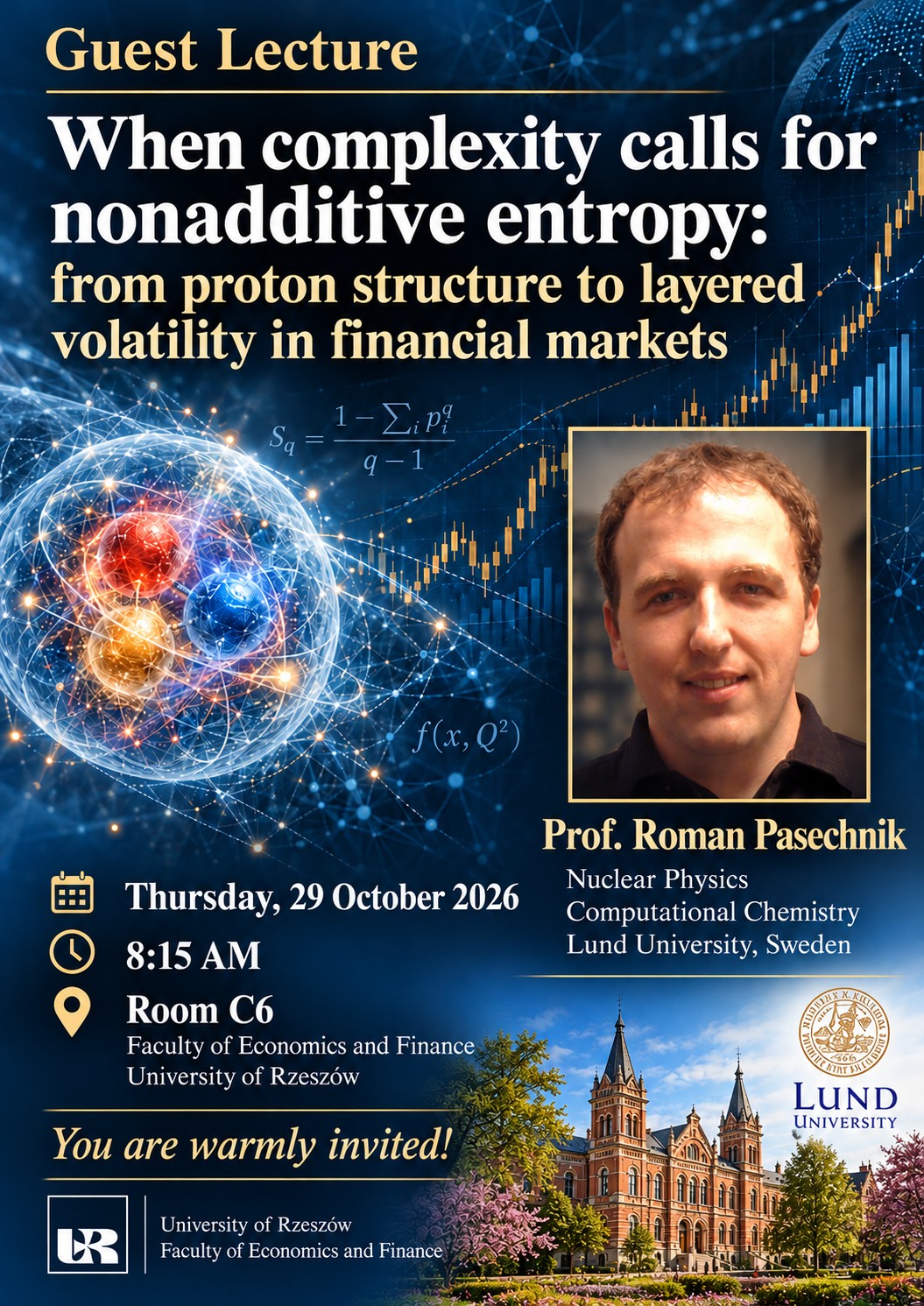
An Interdisciplinary Perspective on Complexity, Uncertainty, and Nonadditive Entropy
On 29 October 2026, the Faculty of Economics and Finance at the University of Rzeszów hosted a guest lecture by Professor Roman Pasechnik from Lund University, Sweden, whose research areas include theoretical physics, high-energy particle and astroparticle physics, and cosmology, as well as the dynamics of complex systems and artificial intelligence.
The lecture, entitled “When Complexity Calls for Nonadditive Entropy: From Proton Structure to Layered Volatility in Financial Markets,” focused on the concept of complexity, nonadditive entropy, and the potential application of mathematical and statistical approaches developed in physics to the analysis of economic and financial phenomena.
The event provided an opportunity to explore the connections between physics, mathematics, statistics, and economics, demonstrating the potential of interdisciplinary approaches to understanding complex systems.
Complexity as a Common Feature of Physical and Economic Systems
One of the central themes of the lecture was the concept of complex systems, whose behaviour cannot always be fully explained by examining their individual components.
Both physical and economic systems consist of numerous interacting elements. These interactions can produce collective behaviour, nonlinear relationships, and outcomes that are difficult to predict using conventional analytical approaches.
In financial markets, price movements do not necessarily result from isolated and independent factors. Instead, they emerge from interactions among investors, financial institutions, information flows, market expectations, and behavioural responses.
Such interdependencies may contribute to sudden changes in volatility, the accumulation of systemic risk, and extreme market events.
Understanding these processes requires analytical tools capable of capturing the interactions and dependencies that shape the behaviour of an entire system.
Nonadditive Entropy: A Different Perspective on Uncertainty
A central concept associated with the lecture was nonadditive entropy, which extends traditional approaches to describing uncertainty and the statistical properties of complex systems.
In conventional statistical frameworks, the entropy of independent systems can be expressed as the sum of the entropies of their individual components. However, this property may not adequately represent systems characterized by strong interdependencies or complex correlation structures.
Nonadditive entropy provides an alternative framework for investigating systems in which interactions among components influence their collective behaviour.
One important example is Tsallis entropy, developed within the broader framework of nonextensive statistical mechanics.
This approach can be particularly relevant when analysing systems characterized by long-range correlations, nonlinear interactions, or probability distributions that differ substantially from conventional statistical assumptions.
Its significance lies in providing additional tools for investigating uncertainty, complexity, and collective behaviour across different scientific disciplines.
From Proton Structure to Financial Market Behaviour
A particularly interesting aspect of the lecture's theme was the connection between two seemingly distant fields: the internal structure of protons and the volatility of financial markets.
In particle physics, understanding proton structure involves investigating interactions among elementary constituents and processes operating across different physical scales.
Financial markets also exhibit complex interactions across multiple scales, ranging from short-term investor reactions to information to longer-term macroeconomic developments.
Although these systems are governed by fundamentally different mechanisms, certain mathematical and statistical methods may be applicable to both.
The connection does not imply that financial markets obey the same physical laws as subatomic particles. Rather, it highlights the possibility of transferring analytical concepts and modelling techniques between scientific disciplines.
This interdisciplinary perspective illustrates how theoretical developments in physics can stimulate new approaches to investigating economic and financial phenomena.
Layered Volatility in Financial Markets
Another important concept reflected in the lecture's title was layered volatility, which refers to the multilevel nature of fluctuations in financial markets.
Financial volatility is neither necessarily uniform nor constant over time. It may emerge from several interacting mechanisms operating across different time horizons and market segments.
For example, short-term price movements may coexist with long-term financial trends, while local market disturbances may spread through interconnected institutions and financial networks.
These interactions can contribute to volatility clustering, nonlinear market dynamics, and extreme fluctuations.
Traditional statistical models may not always capture the full complexity of such processes, particularly when market behaviour departs from standard distributional assumptions.
Nonadditive entropy offers a potentially useful complementary perspective for examining the statistical structure of financial fluctuations and the relationships between different layers of market volatility.
However, the practical value of these approaches depends on empirical validation and comparison with established methods of financial risk analysis.
The Importance of Interdisciplinary Research in Economics and Finance
The lecture's subject highlighted the growing relevance of interdisciplinary research in addressing contemporary economic challenges.
Modern financial markets are characterized by increasing interconnectedness, rapid information flows, nonlinear dynamics, and exposure to unexpected shocks.
Understanding these phenomena requires analytical perspectives that extend beyond traditional economic modelling.
Combining statistical physics, mathematical modelling, and economic analysis may contribute to the development of new research approaches to financial market stability, systemic risk, and uncertainty.
The topic also encourages broader reflection on the role of scientific models in explaining complex phenomena and the importance of recognizing the limitations of conventional analytical assumptions.
Professor Pasechnik's visit provided a valuable opportunity for the academic community of the Faculty of Economics and Finance to engage with interdisciplinary scientific ideas and consider their relevance to contemporary economic and financial research.
The Faculty of Economics and Finance at the University of Rzeszów extends its sincere appreciation to Professor Roman Pasechnik for accepting the invitation and contributing to international academic exchange and interdisciplinary scientific dialogue.