Team leader
Assoc. Prof. Anna Lewińska, alewinska@ur.edu.pl, ORCID 0000-0001-8055-1918
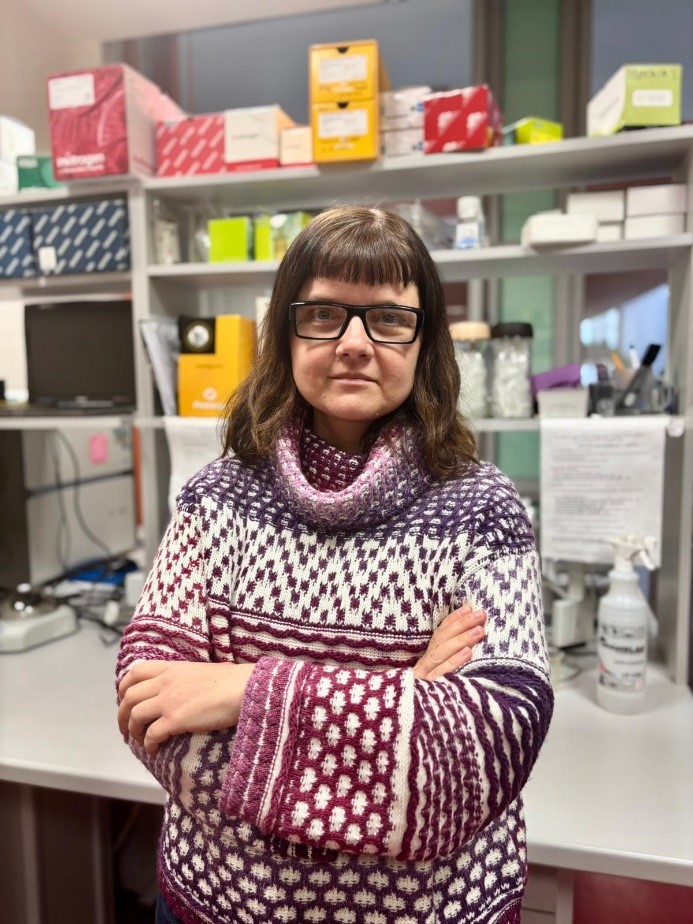
Anna Lewińska received a PhD in biological sciences from the University of Rzeszow, Poland in 2011 (the title of PhD thesis: „The role of flavohemoglobin in the protection against reactive nitrogen species and reactive oxygen species in the yeast Saccharomyces cerevisiae”) and a DSc in biological sciences (habilitation; discipline, biotechnology; specialization, molecular biotechnology, the tile of main achievement: “Molecular mechanisms underlying cancer cell responses to plant-derived nutraceuticals – the evaluation of potential applications in anticancer therapy”) from the Maria Curie-Sklodowska University in Lublin, Poland in 2018. She is currently an associate professor in the Faculty of Biotechnology, Collegium Medicum, University of Rzeszow, Poland. She was awarded START scholarship for young, talented researchers at the outset of their career (The Foundation for Polish Science, discipline biochemistry, 2010). She is serving as an editor or guest editor in several scientific journals (e.g., BBA Reviews on Cancer, Heliyon, Frontiers in Genetics, Frontiers in Oncology). Her general scientific interests are cancer biology, cellular senescence, nanotoxicology, and nano-systems for drug delivery, nutraceuticals, stress responses, and epigenetics.
Members of research group
-
Jagoda Adamczyk-Grochala, PhD; jadamczyk@ur.edu.pl, ORCID 0000-0002-9535-7971
-
Anna Deręgowska, PhD; aderegowska@ur.edu.pl, ORCID 0000-0001-5354-3365
-
Julia Słaby, PhD student; jslaby@ur.edu.pl, ORCID 0009-0002-1906-076X
-
Paulina Stec, MSc Eng, technician, pastec@ur.edu.pl, ORCID 0009-0005-7627-6382
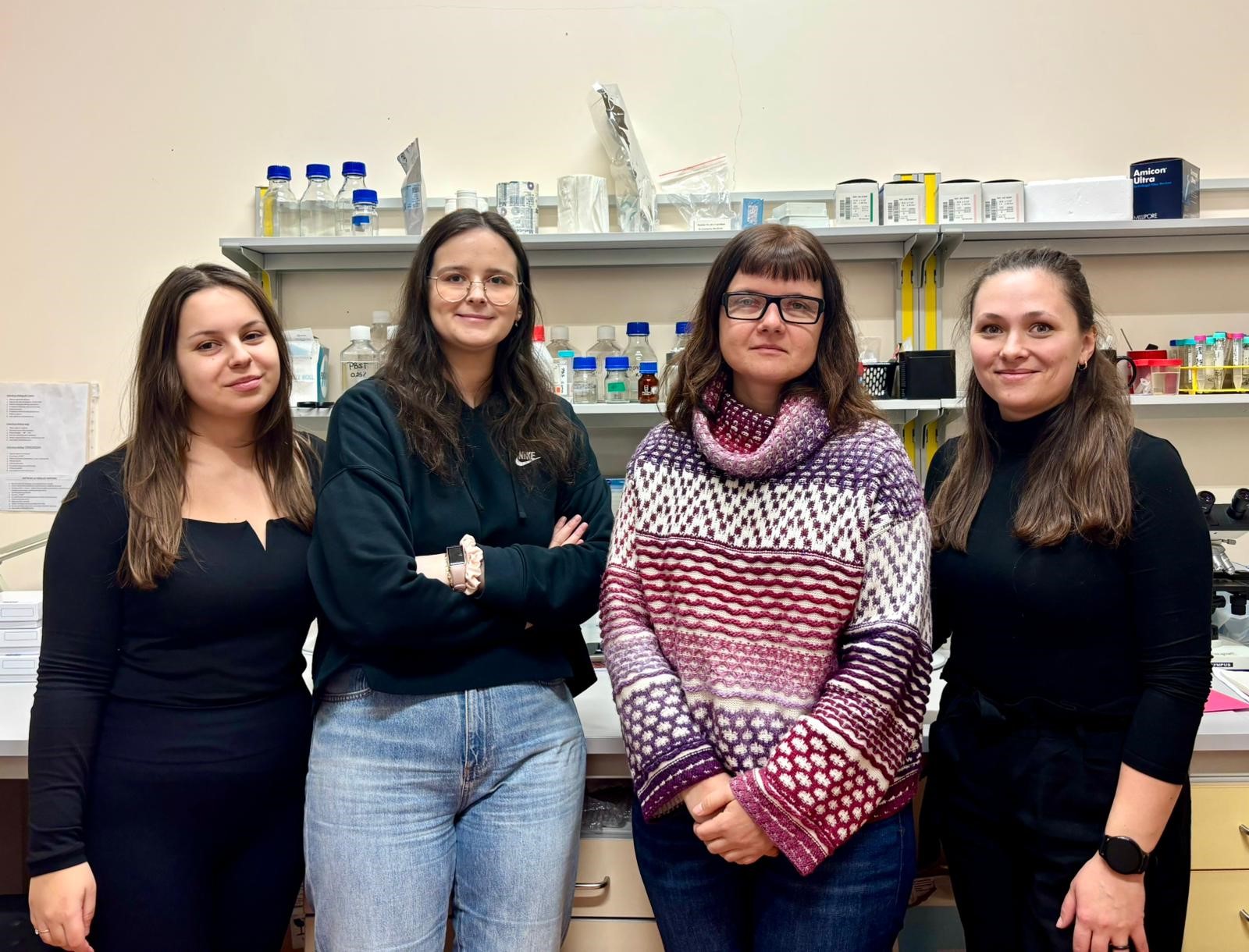
Paulina Stec, Julia Słaby, Anna Lewińska, Anna Deręgowska
Research
Our scientific interest is focused on the biology of cancer cell, especially the responses of cancer cells to drugs and molecular mechanisms underlying drug resistance. One of such response that we are interested in is chemotherapy-induced cellular senescence that might have a significant effect on cancer treatment due to secretory phenotype of senescent cancer cells with proinflammatory potential. Increased secretion of proinflammatory factors may promote cancer cell aggressiveness by the stimulation of cell proliferation, migration and metabolic changes and may have impact on tumor microenvironment, because of induction of secondary senescence in neighboring normal cells potentiating primary proinflammatory effects that may lead to carcinogenesis. One of interesting experimental approaches to limit side effects of the accumulation of drug-induced senescent cancer cells is the use of senolytic drugs – natural or synthetic compounds with the ability to selectively kill senescent cancer cells.
Our team is focused on screening and testing new senolytic compounds against senescent cancer cells of different origin, and the analysis of senolytic action in nano size (nano-senolytics) and the improvement of senolytic and anticancer drug delivery to senescent cells using nanomaterials.
We are also investigating adaptive responses of cancer cells based on changes in intracellular redox state, epigenetic modifications, and metabolic changes with the use of up-to-date biochemical methods, cell and molecular biology tools and bio-imaging techniques.
Special emphasis is placed on the elucidation of the role of selected 5-methylcytosine RNA methyltransferases during cancer cell responses to extracellular and exogenous RNA as novel potential damage-associated molecular pattern (DAMP) signals.
Selected 5 publications (2023-2025)
-
Betlej G, Deręgowska A, Wnuk M, Błoniarz D, Szmatoła T, Klimczak K, Adamczyk-Grochala J, Świętoń J, Lewińska A. TRDMT1 methyltransferase gene knockout attenuates STING-based cell death signaling during self-extracellular RNA-mediated response in drug-induced senescent osteosarcoma cells. Cell Mol Life Sci. 2025 Aug 13;82(1):310. doi: 10.1007/s00018-025-05835-1.
-
Słaby J, Wnuk M, Błoniarz D, Stec P, Szmatoła T, Kaznowska E, Reich A, Moros M, Lewińska A. ITGA1, the alpha 1 subunit of integrin receptor, is a novel marker of drug-resistant senescent melanoma cells in vitro. Arch Toxicol. 2025 Jun;99(6):2611-2625. doi: 10.1007/s00204-025-04028-w.
-
Adamczyk-Grochala J, Wnuk M, Oklejewicz B, Klimczak K, Błoniarz D, Deręgowska A, Rzeszutek I, Stec P, Ciuraszkiewicz A, Kądziołka-Gaweł M, Łukowiec D, Piotrowski P, Litwinienko G, Radoń A, Lewińska A. Evaluation of anticancer activity of urotropine surface modified iron oxide nanoparticles using a panel of forty breast cancer cell lines. Nanotoxicology. 2025 Feb;19(1):50-68. doi: 10.1080/17435390.2025.2450196.
-
Wnuk M, Del Sol-Fernández S, Błoniarz D, Słaby J, Szmatoła T, Żebrowski M, Martínez-Vicente P, Litwinienko G, Moros M, Lewińska A. Design of a Magnetic Nanoplatform Based on CD26 Targeting and HSP90 Inhibition for Apoptosis and Ferroptosis-Mediated Elimination of Senescent Cells. ACS Biomater Sci Eng. 2025 Jan 13;11(1):280-297. doi: 10.1021/acsbiomaterials.4c00771.
-
Lewińska A, Radoń A, Gil K, Błoniarz D, Ciuraszkiewicz A, Kubacki J, Kądziołka-Gaweł M, Łukowiec D, Gębara P, Krogul-Sobczak A, Piotrowski P, Fijałkowska O, Wybraniec S, Szmatoła T, Kolano-Burian A, Wnuk M. Carbon-Coated Iron Oxide Nanoparticles Promote Reductive Stress-Mediated Cytotoxic Autophagy in Drug-Induced Senescent Breast Cancer Cells. ACS Appl Mater Interfaces. 2024 Mar 27;16(12):15457-15478. doi: 10.1021/acsami.3c17418.
Projects (2023-2025)
-
OPUS 22, NCN: “The role of 5-methylcytosine RNA methyltransferases in the regulation of cancer cell responses to extracellular and exogenous RNA”, 2021/43/B/NZ2/02210, 2022-2026 (principal investigator)
-
M-ERA.NET 3 Call 2022: “Senolytic nanoplatform to target and eliminate skin cancer Zombie cells”, Polish team supported by NCN, 2022/04/Y/ST5/00155, 2023-2026 (principal investigator – Polish team)
Patents
-
PL. 442574 Method of obtaining bioactive nonwoven fabric for use as an anti-cancer dressing material.
Scientific Collaboration
-
Instituto de Nanociencia y Materiales de Aragón, INMA (CSIC-Universidad de Zaragoza), C/Pedro Cerbuna 12, Zaragoza 50009, Spain
-
Cancer Biomarker group, Latvian Biomedical Research and Study Centre, Ratsupites 1, LV-1067 Riga, Latvia
-
Istituto di Scienze Applicate e Sistemi Intelligenti "E. Caianiello", Consiglio Nazionale delle Ricerche, Via Campi Flegrei 34, Pozzuoli, 80078, Italy
-
Faculty of Chemistry, University of Warsaw, Pasteura 1, Warsaw 02-093, Poland
-
Center of Experimental and Innovative Medicine, University of Agriculture in Krakow, al. Mickiewicza 24/28, Cracow 30-059, Poland
