Group of Cell Molecular Biotechnology
Team leader
Prof. dr hab. Maciej Wnuk; mwnuk@ur.edu.pl,ORCID 0000-0002-8518-6670
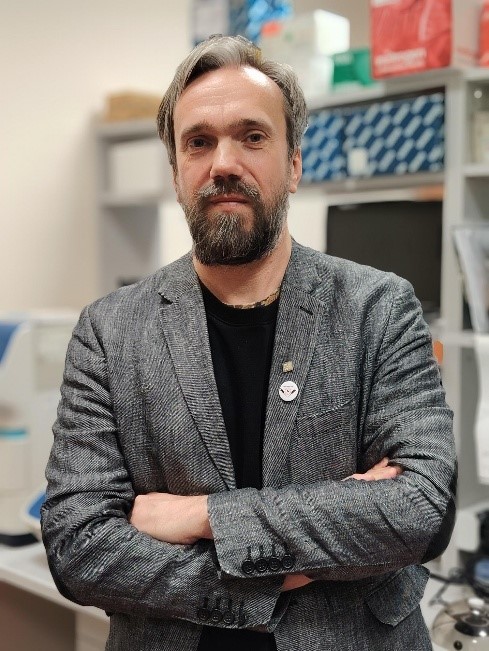
Professor Maciej Wnuk is academic and researcher in the field of Natural Sciences, specializing in Biotechnology. His scientific career is characterized by an interdisciplinary progression across biological, agricultural, and biotechnological disciplines. Professor Wnuk initiated his academic tenure at the University of Rzeszów, where he was conferred a Master’s degree in Biology in 2004. He subsequently advanced his research in the field of Agricultural Sciences, specializing in Animal Science. In 2008, he was awarded a Doctoral degree by the National Research Institute of Animal Production. In 2015, following significant contributions to the advancement of his field, he attained the degree of Habilitated Doctor (dr hab.) in Biological Sciences. The degree was granted by the Faculty of Biology and Biotechnology at the University of Warmia and Mazury in Olsztyn in the discipline of Biology. In recognition of his distinguished scientific achievements and continued leadership in research, he was ultimately awarded the title of Professor. Currently, his primary scientific focus lies within the discipline of Biotechnology, where he integrates foundational biological principles with advanced natural science methodologies. He is expert in navigating complex biological systems and their biotechnological applications. Prof. Wnuk is also a member of the editorial board of Biogerontology (Springer), the publication series “The Healthy Ageing and Longevity” (Springer), the journal Gens (MDPI), the Cancer Research section of the journal Heliyon (Cell Press/Elsevier), the journal Analytical Cellular Pathology (John Wiley & Sons, Inc.), the journal BioMed Research International (John Wiley & Sons, Inc.), and guest editor of the journal “BBA - Reviews on Cancer” (Elsevier). He is also a member of the Council for Scientific Excellence for the 2024-2027 term in the field of biotechnology and secretary of the Biotechnology Committee of the Polish Academy of Sciences.
Members of research group
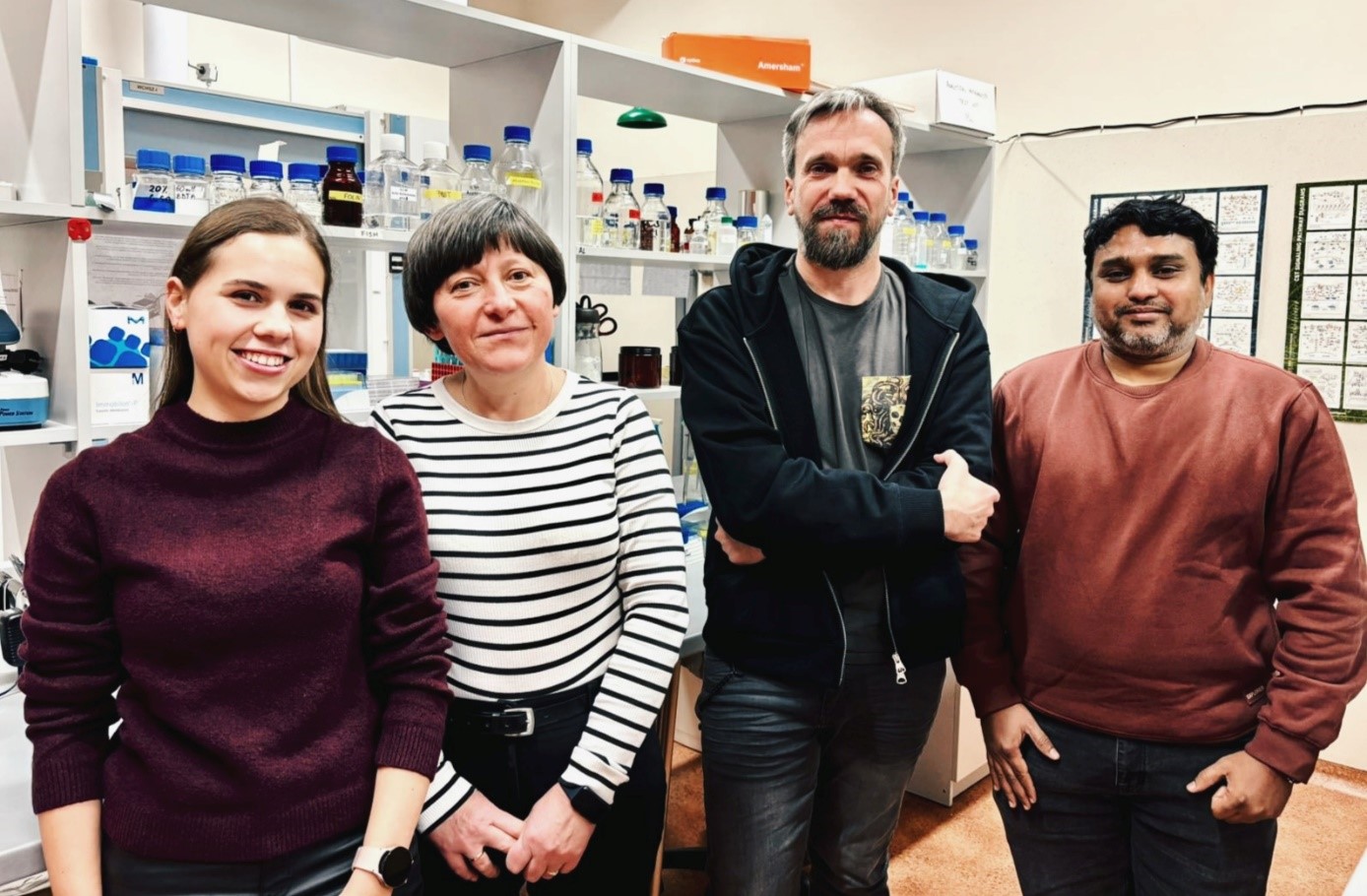
Olga Kołodziej, Bernadetta Oklejewicz, Maciej Wnuk, RaviKumar Kapavarapu (absent: Viera Schwarzbacherová, Angelika Macior-Łannik, Katarzyna Solarska Ściuk)
Research
Research portfolio of the group led by Prof. Maciej Wnuk, based on the provided achievements and scientific trajectory.
1. Advanced Tools for Genetic Instability Analysis
The group has established a unique "methodological workshop" for analyzing DNA at the single-cell level, bridging the gap between basic yeast research, industrial biotechnology, and clinical diagnostics.
-
Pioneering Yeast PRINS: First to adapt the PRINS (Primed In Situ Synthesis) technique for S. cerevisiae. This allows for the in situ detection of rDNA sequences and monitoring nucleolar changes during the cell cycle and oxidative stress.
-
Single Chromosome Comet Assay: A proprietary procedure that analyzes DNA damage and replication stress within individual chromosomes previously separated by PFGE (Pulse Field Gel Electrophoresis). This method offers superior sensitivity compared to traditional population-based assays.
-
Whole Chromosome Painting (WCP) Probes: Developed and patented a panel of probes for labeling entire yeast chromosomes via FISH. These tools are used to monitor spontaneous aneuploidy in laboratory and industrial strains, earning a Silver Medal at the Brussels Innova Exhibition.
-
Flow-FISH & Imaging Cytometry: Recent advancements include adapting cytogenetic protocols for Imaging Flow Cytometry, enabling high-throughput automated analysis of chromosomal abnormalities in yeast suspensions.
2. Nanobiotechnology & Biosafety (Nanotoxicology)
Since 2013, the group has critically evaluated the impact of nanomaterials on human cells, identifying both risks and potential therapeutic benefits.
-
Stress-Induced Premature Senescence (SIPS): Demonstrated that nanoparticles (gold, silver, nanodiamonds) can trigger premature aging in human fibroblasts through the loss of Nuclear Lamina B1 and activation of the p53/p21 pathway.
-
Hormetic Effects: Identified that low doses of certain can act as hormetins, improving cell survival and delaying aging via Nrf2 and FOXO3A pathways.
-
Photostimulated Regeneration: In collaboration with international partners (CNR Italy), the group utilized P3HT polymer nanoparticles for light-dependent control of tissue regeneration in Hydra vulgaris and human keratinocytes.
3. Targeted Oncology & Drug Delivery Systems
The group develops "smart" delivery platforms to enhance the efficacy of chemotherapeutics and overcome drug resistance.
-
Senolytic Nanoplatforms: Current leadership in projects (2022–2026) developing electrospun nanofibers (PEO/PLA) to deliver nutraceuticals (e.g., Quercetin) specifically to eliminate senescent cancer cells.
-
Dendrimer-Based Therapy: Utilization of PAMAM dendrimers (G3) as carriers for Lapatinib and Fulvestrant, showing enhanced elimination of breast cancer cells through autophagy and apoptosis.
-
Magnetic Hyperthermia: Research into Fe3O4 nanoparticles for the targeted destruction of triple-negative breast cancer cells via ferroptosis hyperthermia.
4. Targeted Nanotherapeutics and Dual-Mode Cell Death
A significant research pillar focuses on the engineering of multifunctional magnetic nanoplatforms designed to selectively identify and eliminate resistant cell populations through synergistic pathways.
-
Senolytic Precision Targeting: Developed a magnetic nanoplatform utilizing CD26 targeting to specifically home in on senescent cells. By delivering HSP90 inhibitors directly to these targets, the system triggers a dual-lethal mechanism involving both Apoptosis and Ferroptosis, effectively clearing "zombie" cells that drive chronic inflammation.
-
Surface Modification & Broad-Spectrum Efficacy: Evaluated the anticancer potential of urotropine-modified iron oxide nanoparticles across an extensive panel of forty breast cancer cell lines. This systematic screening proved that specific surface functionalization enhances cellular uptake and cytotoxicity, providing a blueprint for personalized nanomedicine based on specific breast cancer subtypes.
5. Identification of a New Therapeutic Target
A major research pillar involves the comprehensive characterization of the RNA methyltransferase TRDMT1 in cancer biology.
-
Telomere Homeostasis: Proved that TRDMT1 modulates telomere length by interacting with telomerase and regulating TERRA (Telomeric Repeat-containing RNA) expression.
-
Stress Adaptation: Demonstrated that TRDMT1 acts as a pleiotropic factor in the adaptive response of cancer cells to chemotherapy. Its absence sensitizes cells to ER stress but can also promote secondary chromosomal aberrations.
6. Development of Mitochondria-Targeted Flavonoid Derivatives
A primary research focus involves the chemical modification of natural polyphenols to enhance their mitochondrial accumulation and selective toxicity against resistant cancer cell populations.
-
Selective Elimination of Senescent Cells (Senolysis): Demonstrated that mitochondria-targeted Fisetin derivatives specifically compromise mitophagy in drug-induced senescent breast cancer cells. By disrupting the mitochondrial quality control loop, these compounds trigger apoptosis specifically in "zombie" cells that otherwise contribute to tumor recurrence.
-
Metabolic & Genetic Vulnerability: Proved that the efficacy of Quercetin derivatives is highly dependent on the interplay between p53 mutation status and glucose availability. These compounds exploit the metabolic inflexibility of cancer cells, inducing mitochondrial dysfunction more aggressively when glycolytic pathways are restricted.
-
Organelle-Specific Delivery: Utilized lipophilic cations (such as Triphenylphosphonium) to increase the mitochondrial concentration of phytochemicals by several hundred-fold. This targeted approach bypasses general systemic toxicity while successfully disrupting the mitochondrial membrane potential (Δψm) of malignant cells.
7. Induction of Reductive Stress and Autophagic Control
This research line explores the use of carbon-encapsulated nanomaterials to manipulate the redox state and degradative pathways of therapy-resistant cancer cells.
-
Reductive Stress-Mediated Cytotoxicity: Demonstrated that carbon-coated iron oxide nanoparticles induce a profound state of reductive stress in drug-induced senescent breast cancer cells. This biochemical shift disrupts the cell's internal balance, bypassing traditional drug resistance mechanisms.
-
Pro-Death Autophagy: Proved that these nanoparticles promote cytotoxic autophagy, turning a survival mechanism into a cell-death pathway. By forcing senescent cells to digest their own components under stress, the treatment limits their survival and prevents post-chemotherapy tumor relapse.
8. Molecular Modelling of Interactions Between Low-Molecular-Weight Compounds and Proteins: An Integrated In Silico Approach
This research line focuses on the establishment of a high-precision "methodological workshop" designed to bridge the gap between static structural biology and dynamic drug-target engagement. By integrating multi-scale computational tools, the group deciphers the complex thermodynamic and kinetic profiles of low-molecular-weight compounds.
Selected 5 publications (2023-2025)
-
Deręgowska A, Solarska-Ściuk K, Wnuk M, Schwarzbacherová V. Pig as an Interorgan Communication Model and Its Applications in Biomaterials, Drug Delivery, and Bioengineering Research. Compr Physiol. 2025 Oct;15(5):e70043. doi: 10.1002/cph4.70043.
-
Solarska-Ściuk K, Pruchnik H. A Critical View on the Biocompatibility of Silica Nanoparticles and Liposomes as Drug Delivery Systems. Mol Pharm. 2025 Jun 2;22(6):2830-2848. doi: 10.1021/acs.molpharmaceut.5c00501.
-
Tommasini G., Sol-Fernández S. D., Flavián-Lázaro A. C., Lewinska A., Wnuk M., Tortiglione, C. Moros M., Remote Magneto–Thermal Modulation of Reactive Oxygen Species Balance Enhances Tissue Regeneration In Vivo. Adv. Funct. Mater. 2024, 34, 2405282.
-
Lewinska A, Adamczyk-Grochala J, Wnuk M. TRDMT1-mediated RNA C-5 methylation as a novel target in anticancer therapy. Biochim Biophys Acta Rev Cancer. 2023 Nov;1878(6):188964. doi: 10.1016/j.bbcan.2023.188964
-
Collins A, Møller P, Gajski G, Vodenková S, Abdulwahed A, (…) Wnuk M, Wouters A, Žegura B, Zikmund T, Langie SAS, Azqueta A. Measuring DNA modifications with the comet assay: a compendium of protocols. Nat Protoc. 2023 Mar;18(3):929-989. doi: 10.1038/s41596-022-00754-y.
Projects
-
Electrospun nanofiber-based nanoplatform for delivery of new nutraceutical derivatives to eliminate chemotherapy-induced senescent breast cancer cells No. UMO-2021/43/B/NZ7/02129, National Science Center, PLN 2,191,240.00, OPUS 2022-2027
-
The role of DNMT2 methyltransferase in regulating genomic plasticity in cancer cells, 2017/25/B/NZ2/01983, National Science Center, PLN 1 432 920, OPUS 2018-2023
Patents
-
PL244105 Test for detecting homozygous deletion CTTACCTGT in the human FUCA1 gene and method for performing the test
-
PL244546 The non-conventional yeast strain Aureobasidium pullulans URC2 capable of efficient linoleic acid production in standard YPD medium
-
PL240001 Method for producing a natural biocomposite from single-cell microalgae of the genus Planktochlorella sp. as a modulator of microorganism growth using the phenomenon of metabolic photoreprogramming
-
PL247297 Method for obtaining bioactive nonwoven fabric for use in anticancer dressing material
-
PL243045 Production and application of a pigment product based on Serratia marcescens extract as a plastic and artistic material
Scientific Collaboration
-
Instituto de Nanociencia y Materiales de Aragón, INMA (CSIC-Universidad de Zaragoza), C/ Pedro Cerbuna 12, 50009, Saragossa, Spain.
-
Istituto di Scienze Applicate e Sistemi Intelligenti "E. Caianiello", Consiglio Nazionale delle Ricerche, Via Campi Flegrei 34, Pozzuoli, 80078, Italy
-
Organoid Platform Max Delbrück Center Berlin Institute for Medical Systems Biology (MDC-BIMSB), German
-
Department of Biology and Physiology, University of Veterinary Medicine and Pharmacy in Košice, Košice, Slovakia
-
Department of Biomedicine, Neuroscience and Advanced Diagnostics (BIND), University of Palermo, 90127 Palermo, Italy
-
Faculty of Chemistry, University of Warsaw, Warsaw, Poland, Łukasiewicz Research Network - Institute of Non-Ferrous Metals, Gliwice, Poland
-
Center for Experimental and Innovative Medicine, The University of Agriculture in Krakow, Redzina 1C, 30 248, Krakow, Poland
-
Laboratory of Genomics, National Research Institute of Animal Production, Krakowska 1, Balice 32-083, Poland.
