Group of Analytical Biotechnology
Team leader
Assoc. Prof. Ewa Szpyrka; eszpyrka@ur.edu.pl, ORCID 0000-0001-6145-8486

Ewa Szpyrka graduated from the University of Technology in Rzeszow, received her PhD (2006) and habilitation (2016) in agronomy (Institute of Plant Protection – National Research Institute in Poznan). Co-author of 150 peer-reviewed publications, co-inventor of 6 patents, supervisor of 3 defended and 1 ongoing PhD thesis. Investigator of 5 research grants founded by National Science Center, Podkarpackie Innovation Center, Ministry of Science and Higher Education. Member of the Instrumental Analysis Section, Committee on Biotechnology of the Polish Academy of Sciences.
Members of research group
-
Magdalena Słowik-Borowiec, PhD, DSc, Associate profesor; mslowik@ur.edu.pl, ORCID 0000-0002-4436-8638
-
Anna Górka, PhD; agorka@ur.edu.pl, ORCID 0000-0002-1460-840X
-
Paulina Książek-Trela, PhD; pksiazek@ur.edu.pl, ORCID 0000-0002-2819-9205
-
Dagmara Migut, PhD; dmigut@ur.edu.pl, ORCID 0000-0003-2382-7353
-
Magdalena Podbielska, PhD; mpodbielska@ur.edu.pl, ORCID 0000-0003-1329-993X
-
Karol Skrobacz, PhD; kskrobacz@ur.edu.pl, ORCID 0000-0003-2105-9119
-
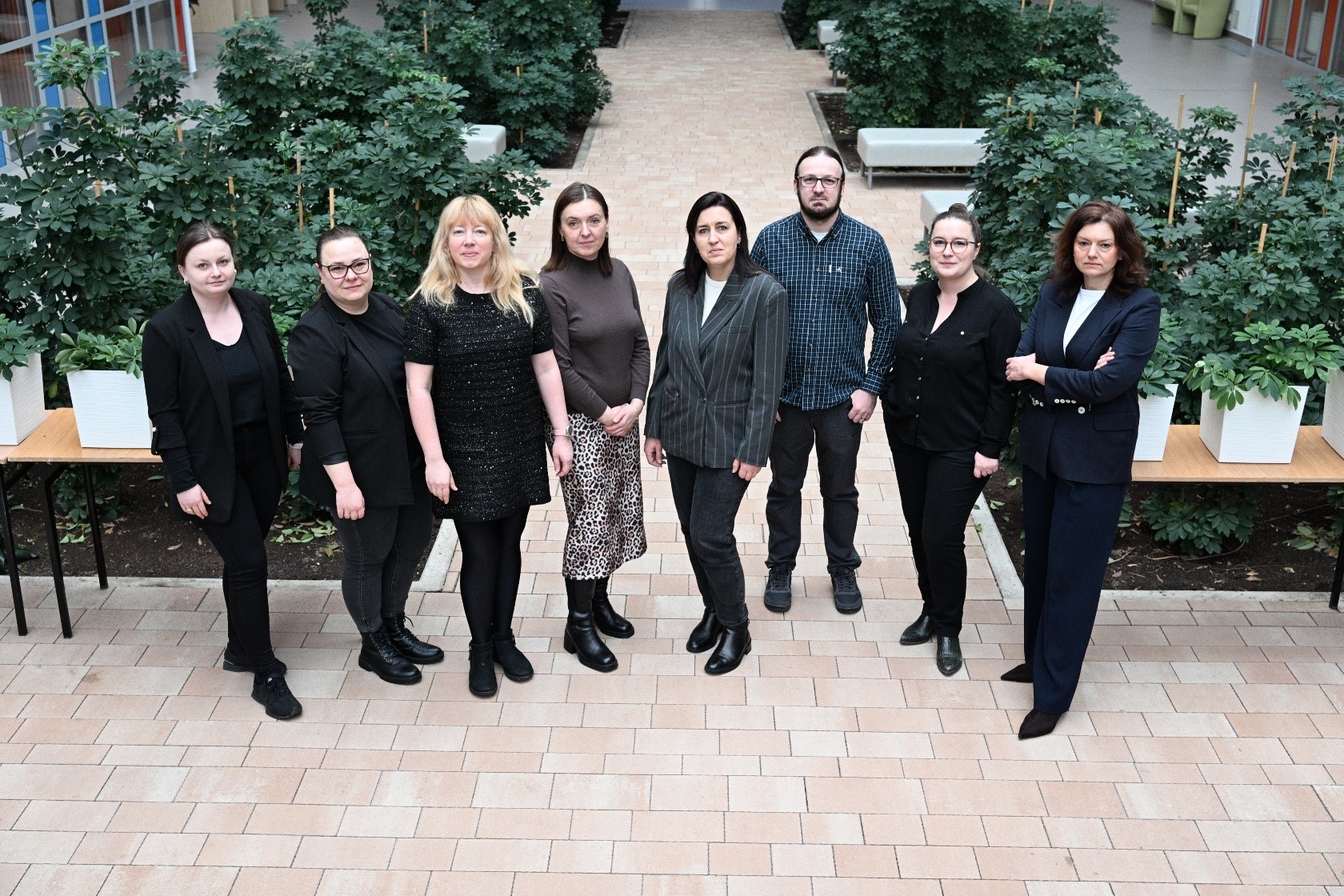
Paulina Książek-Trela, Dagmara Migut, Anna Górka, Aneta Zwolak, Ewa Szypyrka, Karol Skrobacz, Magdalena Słowik-Borowiec, Magdalena Podbielska
Research
The research focuses on the development of analytical methods in biotechnology. Team members specialize in chromatographic analyses using liquid chromatography (HPLC), gas chromatography coupled with tandem quadrupole mass spectrometry (GC-MS/MS), pyrolysis–gas chromatography–mass spectrometry (Pyr-GC-MS), Atomic absorption spectrometry, and inductively coupled plasma mass spectrometry (ICP-MS).
Laboratory participates in several main research projects:
1. Environmental contamination and exposure assessment.
We conduct comprehensive analyses of soil, surface and groundwater, air and plant materials to assess contamination by microplastics, heavy metals, and persistent organic pollutants such as PAHs, PCBs, and PBDEs. Our work contributes to understanding environmental distribution, transformation, and human-relevant exposure pathways of emerging contaminants.
2. Biotechnological approaches to pollutant degradation.
We study factors influencing the dissipation of pollutants, their biodegradation by microorganisms, and effective microorganisms used in agriculture. We focused on pesticides, especially on herbicides with long half-life periods. We also search for new microorganisms, isolated from the environment, capable of degrading persistent herbicides.
3. Food and plant product quality analysis.
We focus on the design and optimization of food products with health-promoting properties. Our research includes the isolation, characterization, and assessment of the biological activity of bioactive compounds. Particular emphasis is placed on assessing the impact of food processing methods on the stability and preservation of the biological activity of these substances.
4. Plants, plant-derived products, and chemical environmental stressors.
Our research in this area focuses on the assessment of plants and plant-derived products exposed to chemical environmental stressors, particularly pesticides and heavy metals. We conduct detailed compositional analyses of medicinal and aromatic herbs as well as other plant-derived products, determining heavy metal content and profiles of bioactive compounds relevant to food safety and nutritional quality. Particular emphasis is placed on oxidative stress responses, biodegradation-related processes, and ecosystem health, including, in selected studies, the assessment of the effects of plant-derived compounds on microorganisms, contributing to a broader understanding of plant–environment and plant–microorganism interactions under chemical stress.
5. Ecological effects of emerging contaminants like micro- and nanoplastics on aquatic environments.
We analyse the effects of individually contaminants as well as applied in combination with microplastics on algae growth parameters.
6. Biochemical and physiological responses of plants to abiotic stresses in crop production.
Our scientists also conduct research on the physiological mechanisms of plant responses to abiotic stresses, including analysis of photosynthetic efficiency and the functioning of antioxidant systems, as well as on the relationships between environmental chemical properties, abiotic factors, and biological processes.
All of our research integrates advanced analytical methods with issues of environmental biotechnology, plant systems biology, and the assessment of the quality and safety of biological raw materials.
Selected 5 publications (2023-2025)
-
Podbielska M, Szpyrka E. Microplastics - An emerging contaminants for algae. Critical review and perspectives. Sci Total Environ. 2023 Aug 10;885:163842. doi: 10.1016/j.scitotenv.2023.163842.
-
Słowik-Borowiec M, Zdeb G. Kinetics of the dissipation of azoxystrobin, quizalofop-p-ethyl, fluazifop-p-butyl and clomazone in fermented legume seeds. J Food Compost Anal. 2024 Mar 127:105993, doi: 10.1016/j.jfca.2024.105993.
-
Amirian V, Russel M, Yusof ZNB, Chen JE, Movafeghi A, Kosari-Nasab M, Zhang D, Szpyrka E. Algae- and bacteria-based biodegradation of phthalic acid esters towards the sustainable green solution. World J Microbiol Biotechnol. 2025 Jan 7;41(2):24. doi: 10.1007/s11274-024-04243-0
-
Książek-Trela P, Potocki L, Szpyrka E. The impact of novel bacterial strains and their consortium on diflufenican degradation in the mineral medium and soil. Sci Rep. 2025 May 24;15(1):18051. doi: 10.1038/s41598-025-02696-3.
-
Podbielska M., Szpyrka E. Advanced chromatographic techniques for assessing human-relevant exposure pathways to micro- and nanoplastics. Sci Total Environ. 2025 Dec 1008: 181054, doi: 10.1016/j.scitotenv.2025.181054
Project
-
Programme Regional Initiative of Excellence. Agreement No. RID/SP/0010/2024/1, Minister of Science of the Republic of Poland.
Patents
-
PL247999 Debaryomyces hansenii yeast strain and its use in oleamide production.
-
PL244913 A new strain of microalgae Parachlorella kessleri DB1 capable of efficiently producing essential fatty acids and beta-glucans.
-
PL244529 Method of preparing samples of plant material and soil for the analysis of polycyclic aromatic hydrocarbons.
-
PL244546 The non-conventional yeast strain Aureobasidium pullulans URC2 capable of efficient linoleic acid production in standard YPD medium.
Scientific Collaboration
-
University Institute of Health Sciences (Gandra, Portugal).
-
Aristotle University of Thessaloniki (Thessaloniki, Greece).
-
Dalian University of Technology (Dalian, China).
-
Rzeszów University of Technology (Rzeszów, Poland).
